Below you will find data related to posters that will be presented at the 2026 FNDS meeting.
See their website here
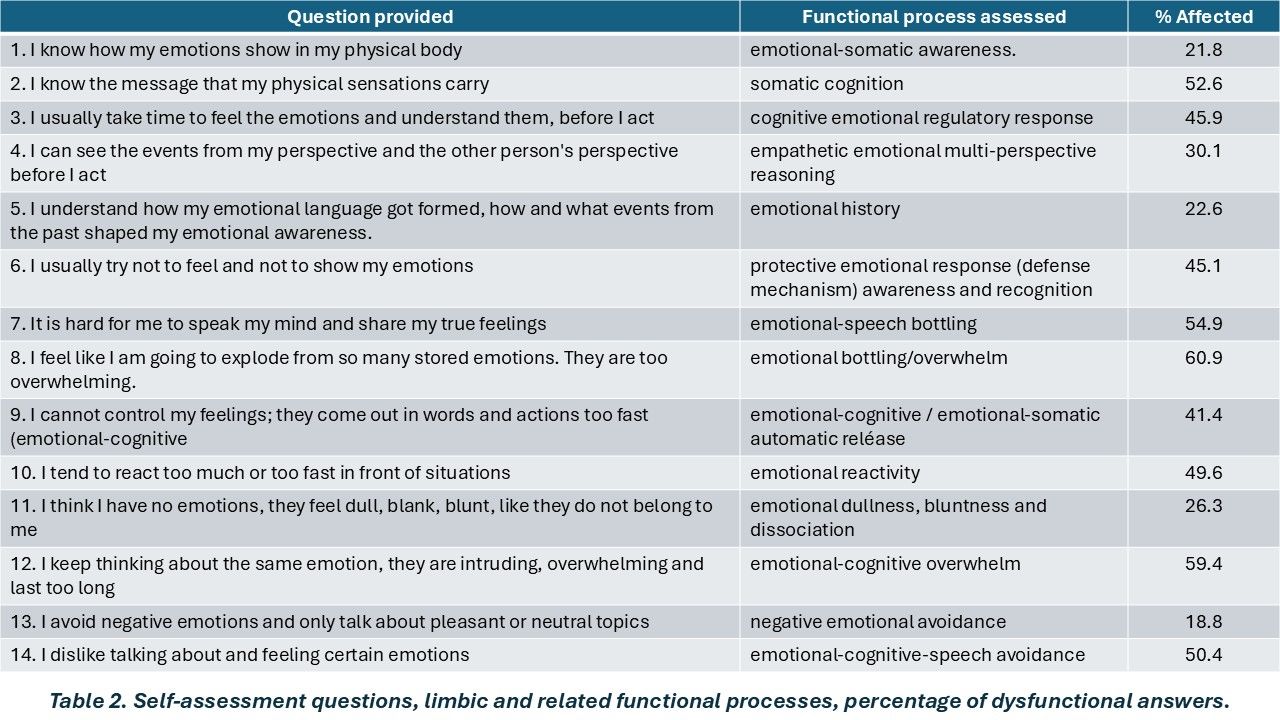
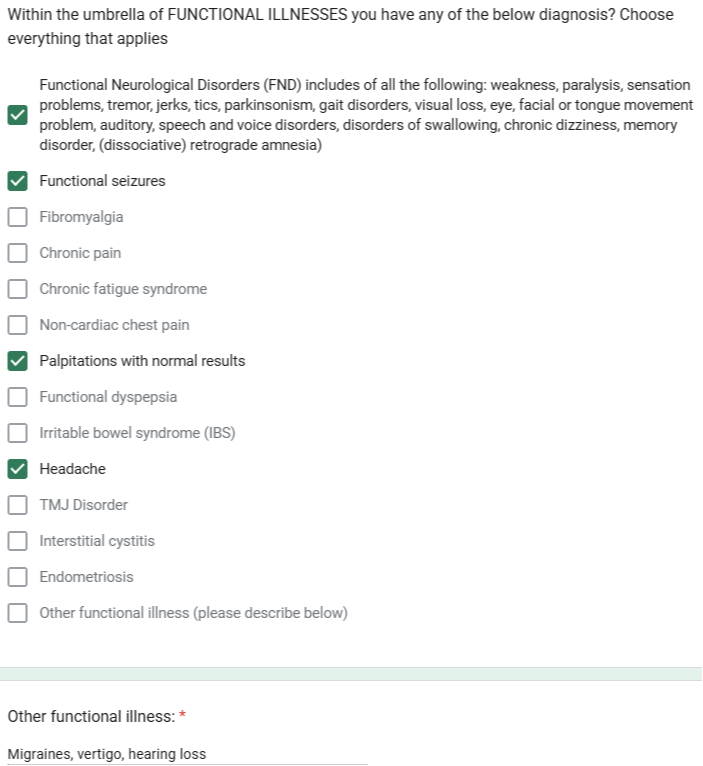
Poster #1. Assessment of 14 limbic and interrelated networks’ functional processes in 133 individuals.
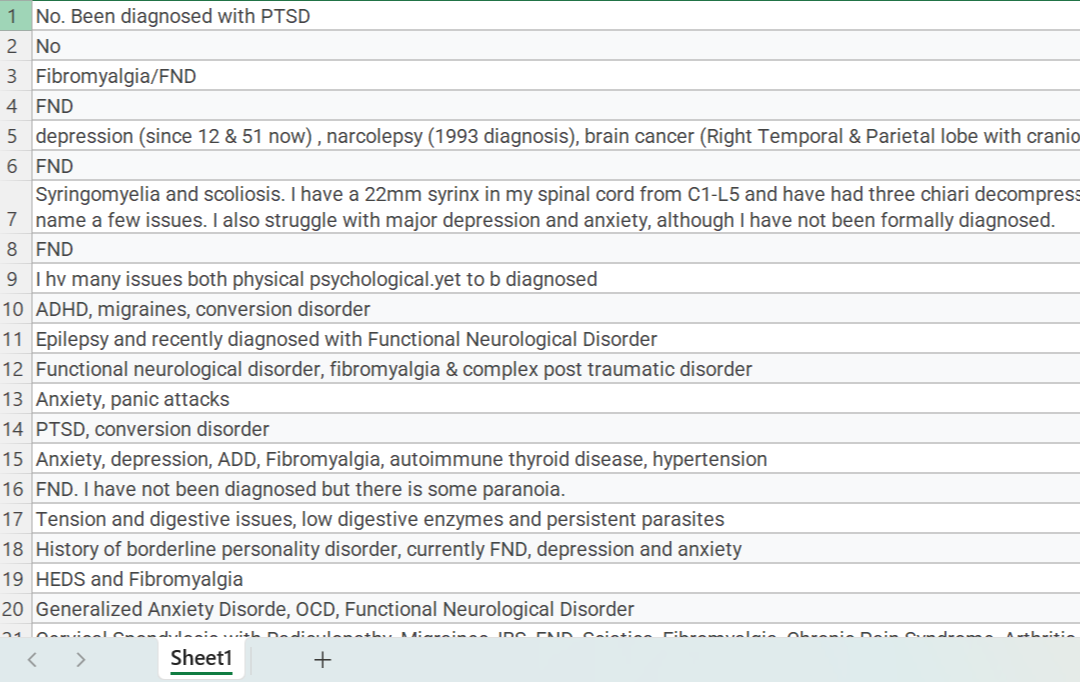
Table 1. Functional and physical medical conditions reported by respondents.
(Touch on the image to download Excel file).
----------------------------------------------------------------
Poster #2. Subjective Functional Markers after 2 years of
EXPERIENTIAL EDUCATION METHODOLOGY.
Level 3 assessment. Participants 1-5
Level 4 assessment. Participants 1-5
Download Database 1 (participants’ demographics, diagnosis, previous treatments used and other characteristics of interest in excel form) BY CLICKING IN THE BELOW IMAGE
----------------------------------------------------------------
Poster #3.
USE OF NATURAL PSYCHEDELICS IN COLORADO, USA. PARTICIPANTS’ OPINIONS (Season No.1 2025)
Read full screening questionnaire with participants' characteristics by clicking in the image below.
Read and download full and detailed FEEDBACK questionnaire, with opinions, by clicking in the image below.
-----------------------------------------------------------------------------
Poster #4.
HEALTHCARE PROFESSIONAL – PATIENT IATROGENIC NEGATIVE FUNCTIONAL HITS: AN EXPERIMENTAL STUDY.
- PF and Dr. F’s conversation. Afternoon time reflected in X minutes and YZ seconds.
- Report on observations, interpretations, and Dr.V's revelations about harmful psychological techniques (integrative or not) used by Dr.F., and how they could negatively affect FP.
- Audio and video recording available under confidentiality agreement and authorization.
- Total duration of the record: 69'34s. Only the first 10'40s are reported here.
- Harmful interventions or “iatrogenic negative functional hits” numbered between parenthesis ().
- First significant report starts 5' minutes and 48s after door opening.
- SUMMARY:
000 - Doors open. Introductions and greetings. Unrelated talks start about Dr. V's methodology. Then Dr.F. directs her technical questioning to patient PF:
5'48s - PF talks about “improving socialization”.
620 – Dr. V. asks PF…..... Dr. F responds (1-lack of regulation) by interrupting (2-sudden motor activation) them "this is your home" (3 – confusing and invalid statement. It is Dr.F’s office).
626 - Dr. F. interrupts PF again (4).
Although interruptions are commonly used in professional-patient encounters, there must be a valid and positive reason, intention and following statement or action, in benefit of the patient being served. Otherwise it could be considered harmful, especially considering the historical harms inflicted on the Functional Neurological Disorders (FNDs) population.
705 - Dr. F. responds "Uff" and “Was it as always?" (5- keeping past patterns alive throughout time).
Dr.F. is asking a question with a suggested answer, or with a preformed complexly meaningful suggested answer (leading questions). They are not neutral, as a healthcare professional knows they should be. This could happen as the result of psychoanalysis and/or hypnotic techniques. Such functional hits could engender, create and maintain harmful dysfunctional patterns of both types, process and cognitive content.
725 - Dr. F.: "and not with MS (PF’s female partner) either" (6-stating something relatively negative about his partner).
740 – Dr. F. addressing Dr. V: "And how did you see him? uncomfortable?" (7- assuming or leading a negative estate in PF)
810 - Dr. F.: "What happens is that many times that discomfort, there has been a lot of time, now he has improved that."
There has been a long time when he did not face situations. He tried to avoid rejection, so he interacted less. Then, there was a moment when he was very uncomfortable interacting. But it is more because of avoidance, than because of real discomfort (8-naming PF’s experience). But I know that, in that situation because there is his mother-in-law, there is his father-in-law, it is complicated (9- naming a situational experience lived by PF). Because they treat him as if he was worthless (10-naming and affirming a negative experience in PF derived from an environmental factor. Complex or dual negative functional hit).
There is something else besides society. If there was a group of unknown people, it would be better than with them (11 – describing negative future relationship conditions with close relatives), who are there besides him all the time (12-remembering or reviving certain relationship traits), like... trying not to intervene too much because things don't happen that way" (13-confusing phrase).
907 - PF "no inter..., no interveng.., no intevino" (PF’ SPEECH CHANGES. HEAD AND BODY ABNORMAL AND INVOLUNTARY MOVEMENTS START IN FRONT OF THE HEALTHCARE PROFESSIONAL - video available)
908 - Dr. F continues: "And people nevertheless with him, when he is unknown, usually come closer. (14-associating a dysfunctional state of quasi cognitive contraction with an environmental reward). He is more connected to new people, as it happens with sports, preferably with sports buds, than with old acquaintances...” (15-describing PF in his own presence, speaking in third person, a pattern commonly seeing in parent-child relationships or other dependent relational states).
1040 – Dr. V shows confusion within herself, repeating Dr. F's words as if they were PF's "uff".
This last phenomenon involving Dr. V, the observer and investigator, shows how any brain can be negatively functionally affected, aligned with epidemiological data. We commonly see FND and other functional disorders (FDs) across healthcare workers, diverse socio-economic spheres of society, professional fields, ages, cultures, cognitive levels and Intelligence Quotients.
Proportion negative hits / minute = 3 negative functional hits per minute (NEFHIM).
-----------------------------------------------------------------------------
Poster #5.
Coming soon....
Join Our Newsletter
(sent monthly to every 3 months)