
Current Care And Treatment Options: Patient-Provider Series Talk #6
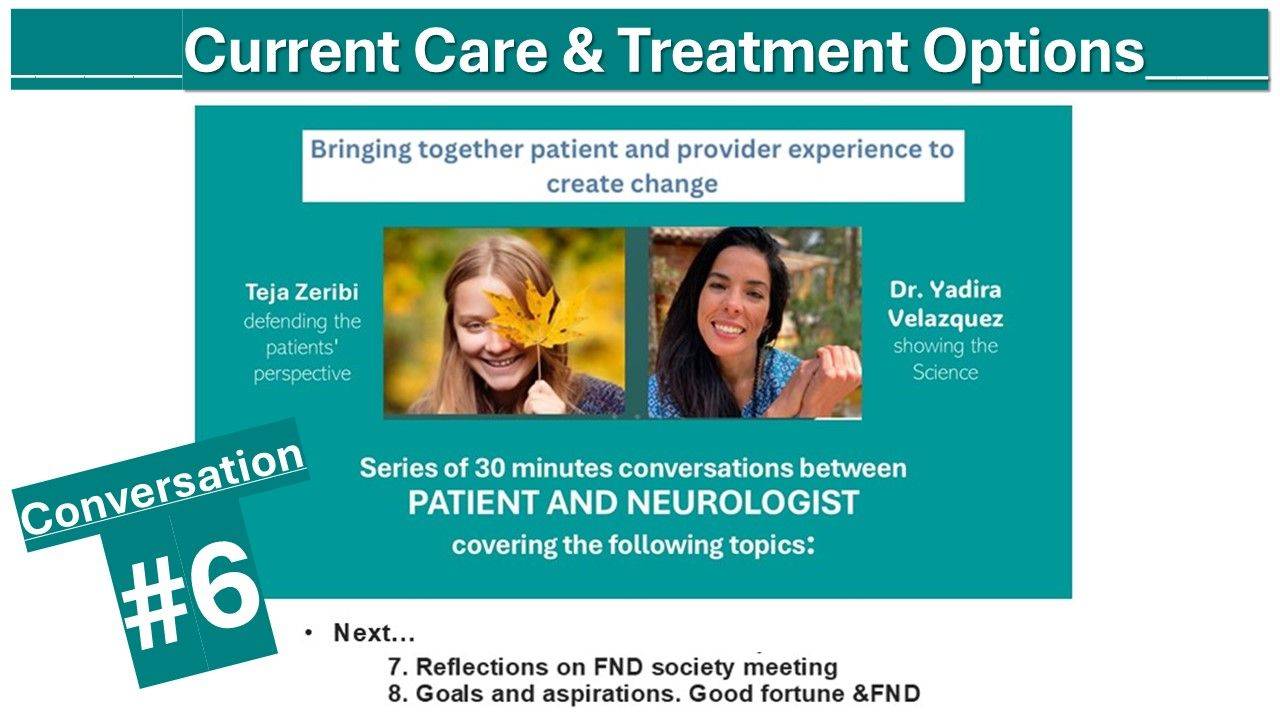
Dec 21, 2025This video covers a conversation between Dr. Yadira Velazquez and Teja Zeribi.
Dr. Velazquez is a Neurologist and Clinical Neurophysiologist specializing in the treatment of functional disorders and educating providers, patients, and the general community about functional disorders.
Teja is a Functional Neurological Disorder (FND) patient, who primarily experienced functional dissociative seizures, and is also a peer support leader for people with FND and runs peer to peer support meetings, as well as the research coordinator for FND Hope and is currently studying pharmacy.
This conversation highlighted the broad topic of “Current care and treatment options”, focusing on the role patients and providers play in how this can be dismantled, and briefly on how this stigma came to existence and is continued to be perpetuated.
The goal of these conversations is to bring together expert experience from both patients and providers to come to an understanding on the experiences and future directions for functional illness patients.
Here is a final reflection from Teja regarding this: (watch full video on YouTube)
This conversation for me highlighted the value of education of and modeling to current and future medical providers of how to provide compassionate and effective care for FND patients. It is my belief that current attempts to make care “efficient”, such as providing the same standardized workbooks to every patient, potentially thereby increasing access, have a high risk of also substantially minimizing efficacy.
Finding a balance between care that can be sustainably provided and cost effective to a population of complex patients with different comorbidities, heterogenous symptom presentations and underlying causes, etc. is not an easy feat. That said, FND is incredibly complex and individualized. Funding for care and time spent with patients for care should be underdressed to reflect this, and results in less healthcare presentations and costs in the long term, due to better outcomes.
There is starting to be a shift towards this model of care, and I encourage all providers and hospital systems/programs to embrace this way of treating FND patients, recognizing limitations of systems.
As a pharmacy student myself, I also see the tremendous power of modeling effective care to students (see one, do one, teach one in a nutshell). Many well established, incredibly competent and successful career providers feel uncomfortable treating FND, and this may translate into poor or stigmatized care. I believe that this trickles down to current students, and risks creating a cycle that further prolongs research and novel treatments helping patients in a timely fashion. One way to mitigate this is to continue to amplify the voices who do feel comfortable and have found success in treating FND, and increasing access to continued medical education resources for the disorder.
As someone who has tried numerous treatments, I offer this advice to patients currently in or seeking care. While in care (and after), regularly checking in with yourself to see if and how it seems to be working is critical. Trust yourself. This can offer insight into things you should amplify/decrease in your treatment (IE sensory tools really seem to help me, but I struggle with breathing exercises). This can tell you a lot about your nervous system and give you a sense of autonomy over your own regulation and body. In an ideal world, you won’t need care forever, and having insight into what helps you is critical to move forward, regain independence, and can improve your current care.
FND might feel unfair, and provides a lot of incredible challenges -but you are worth fighting for, and sometimes the only path out is through. At the end of the day, no matter how much support and excellent care you have, you have the most insight into your own experiences, and that is an essential tool to recovery.
What ideas do YOU have?
Watch FULL video interview here
Connect with Teja: t.zeribi1@uni.brighton.ac.uk
Ready to connect? Contact me now :) - Dr. V.
Are you ready to engage in the Awaken Level 1 course? Ready to continue moving upwards on the ladder of Functional Awakening?
Would you like a 30’ personalized and free introductory conversation? Request it by completing the anonymous Self-Assessment questionnaire: Holocene Method: The Health of the 4 Universal Bodies/Neuronal Networks.
Disclaimer: Dr. Velazquez has not had the chance to review the above article for scientific accuracy, grammar or orthography, nor is she endorsing any type of opinion, comment, suggestion, product or treatment possibly mentioned. You are the sole responsible for the interpretation of the data shared by our Patient Collaborators or Personal Experts. Whenever in doubt you can contact directly the person who wrote this Blog Post article and/or you can report any concerns to Science & Shamanism, LLC, Dr. Velazquez and/or her designees. We will always try to help! Within the limitations of our human existence and capabilities, considering scarce time and high workload.
Join our Mailing list!
New inspiration and information delivered to your inbox.
We will never sell your information, for any reason.
